We would like to congratulate everyone for participating in our Mini Olympics Held at SJWMS, July 30, 2013. We are so proud of you. Again, you showed great and full cooperation, good sportsmanship and the fact that everyone enjoyed this mini sports day. To the admin, staff, teachers, parents and students thank you so much for the support. As always, we did it again. Congratulations to everyone.
»» read more
Showing posts with label st.johns wort. Show all posts
Sunday, August 11, 2013
Friday, December 21, 2012
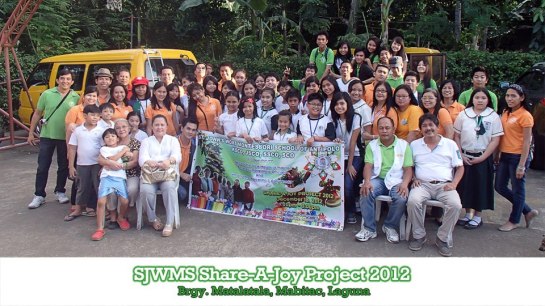
Share-A-Joy 2012
Unknown
- 3:41 PM
- 0
comments
Labels: christmas, mabitac laguna, sjwms, sjwms share a joy 2012, st.johns wort
Sharing our blessings with others is one of the greatest acts that we can do. It doesn't even need a force or unwilling effort because everybody felt so blessed and lucky to be a part of this untiring project of SJWMS. And all of us are part of this great giving. With St. John's Wort Montessori School of Antipolo, from our beloved directress Ma'am Rosalie Girado, down to our teachers, parents,staff and students, they all have the Love to share. Looking through the eyes of each person in Mabitac, Laguna where we brought the food, clothes, toys and others that we all were joint in gathering all these, you will find the true happiness where the genuine spirit of Christmas lies in our hearts. We would like to thank God most of all in giving us the good weather and the great opportunity to visit these people and shared what we have for them. We must always remember that in every simple things and simple ways that we can show great Love and Joy to others, we must always take advantage of it coz by doing so, you will find the true meaning our worth...with Peace and Contentment in our hearts. Merry Christmas to everybody! May the good Lord brings us more on the coming days and thank you for sharing your great hearts with us especially with the people in Mabitac, Laguna. To God be the glory!
Thursday, November 29, 2012
Share-A-Joy
Unknown
- 12:27 AM
- 0
comments
Labels: jsco, ksco, mabitac laguna, private school antipolo, share a joy, sjwms, ssco, st johns students, st.johns wort

Our Dear Parents and Students, Christmas is the season of Love, Giving and Sharing. In SJWMS we teach our students not just to receive but to give in this great time of the year! In this regard, our Kiddie Student Council Organization, Junior Student Council Organization, and the Senior Student Council Organization Officers will be spearheading a SHARE-A-JOY PROGRAM at our target community in Mabitac, Laguna on December 18, 2012. We would like to include all students in this worthwhile endeavor by their whole-hearted contribution each week to be endorsed to their Class Advisers.
You are very much welcome to give more than what is indicated and / or if you have other things and ideas to share, feel free to get in touch with us the soonest possible time. God bless you and may the Spirit of Christmas linger in our hearts now and forever! May the force be with you!
Merry Christmas!
Message from:
From the editor of this website:
Please feel free to visit our website http://sjwmsantipolo.tumblr.com/page/2 to track what we have accomplished from our last Share-A-Joy program. This is not a matter of how much money or its value but what matters is you are giving whole-heartedly. We are not just giving the best education but we also teach children some values that they will bring on as they leave the school…We would like to let them realize that giving is joy and this is one of the most important values that one should have. We are one family and we are all-in-one belief that it won’t hurt if you will just give to the best that you can. A simple and small things that we can give may bring GREAT JOY to others.
Thank you for sharing. The Lord will give the blessings back to you more than what you expect.
From
stylepinay
From the editor of this website:
Please feel free to visit our website http://sjwmsantipolo.tumblr.com/page/2 to track what we have accomplished from our last Share-A-Joy program. This is not a matter of how much money or its value but what matters is you are giving whole-heartedly. We are not just giving the best education but we also teach children some values that they will bring on as they leave the school…We would like to let them realize that giving is joy and this is one of the most important values that one should have. We are one family and we are all-in-one belief that it won’t hurt if you will just give to the best that you can. A simple and small things that we can give may bring GREAT JOY to others.
Thank you for sharing. The Lord will give the blessings back to you more than what you expect.
From
stylepinay
Bonifacio Day
Unknown
- 12:26 AM
- 0
comments
Labels: bonifacio birthday, bonifacio day, sjwms, st johns students, st.johns wort

NO CLASSES ON NOV. 30, 2012, FRIDAY
The declaration of Nov. 30 as a national holiday started when the Philippine Legislature passed Act No. 2946 on Feb. 16, 1921, making that day of each year a legal holiday to commemorate Bonifacio's birth. Bonifacio was the light that guided the revolution. The struggle for freedom he and the Katipuneros started became the inspiration of other revolutionary groups to continue the fight for freedom. NO CLASSES ON NOV. 30, 2012, FRIDAY.
Sunday, November 4, 2012
Back from Vacation
We're back from vacay SJWMS Students! We have a lot to do in the coming days in November. Keep updated! Keep God as the center in everything that we do. Don't forget to thank HIM as always! Let us also honour our parents who are impossibly tiresome giving us all the love, care and support, as well from our family, friends and relatives. St. John's Wort Montessori School of Antipolo is your second home and we are ONE FAMILY! Let's have joy and peace to one another!!! See you all!Saturday, October 27, 2012
SJWMS at NFSDC 2012
Unknown
- 2:41 AM
- 0
comments
Labels: field trip 2012, moa, robot zoo, st johns students, st.johns wort
A day at the Robot Zoo-Nido Fortified Science Discovery Ctr.
We had seen different Robots using Biomechanics Technology. We have dealt with Robot Platypus, Robot Grasshopper, Robot Giraffe, the House Fly, Gigantic Squid, Robot Bat, The Chameleon and a lot more...Everybody, our students, parents and teachers were able to witness the technology that the Robot Zoo has. They had seen lots of things, read a lot of information about how this technology was used to run these robot animals too.One good part here was that, some if not most were able to get interested in knowing their sizes, their features and their techniques how they protect themselves from their enemies and a lot more...
.JPG)
Chameleon
It is an animal that belongs to a highly specialized group of Lizards. Chameleonschange color not so much to blend into the surroundings, but rather to signal, fend off rivals, or attract a mate as well.
Robot Platypus.JPG)
Have your kids a blast of these robotic animation that imitates the real-life behaviors of some most amazing animals in the world. Let them experience the nature and the animals in a different way.
Robotic Zoo is accessible at the Nido Fortified Science Discovery Center Exhibit Hall, 2nd level of SM Mall of Asia, Pasay City
For more info, pls check their website http://www.sciencediscovery.ph/
Robot Grasshopper
It has a bundle of nerves called, "Ganglia"throughout its body instead of brain. It is an animal that has two compound eyes that consist hundreds of individual "eyelets" to watch out for danger. A grasshopper has movable jaws that move from side to side rather than up and down.
It is an animal that belongs to a highly specialized group of Lizards. Chameleonschange color not so much to blend into the surroundings, but rather to signal, fend off rivals, or attract a mate as well.
Robot Platypus
Have your kids a blast of these robotic animation that imitates the real-life behaviors of some most amazing animals in the world. Let them experience the nature and the animals in a different way.
Robotic Zoo is accessible at the Nido Fortified Science Discovery Center Exhibit Hall, 2nd level of SM Mall of Asia, Pasay City
For more info, pls check their website http://www.sciencediscovery.ph/
Wednesday, October 24, 2012
Happy Halloween SJWMS studs!
Sidewalks full of Trick or Treaters,
Lots of little candy eaters,
In their costumes having fun,
Halloween's for everyone.From door to door the bells are ringing
Knockers, knocking, voices singing,
Children, the old and in between
Celebrating Halloween
Lots of little candy eaters,
In their costumes having fun,
Halloween's for everyone.From door to door the bells are ringing
Knockers, knocking, voices singing,
Children, the old and in between
Celebrating Halloween
Happy Halloween SJWMS studs! Let us make this season worthwhile for everybody regardless of our differences in beliefs. Unity in God is what's important. Bonding time with the family, chit chats, and uh! what could we ask more for a quality time with our loved ones? This is it, guys! Enjoy your vacation. Always pray and keep our minds, body and soul healthy! See you next...
Thursday, October 18, 2012
Dambana ng Kagitingan with St. John's Wort Montess...
Unknown
- 7:18 PM
- 0
comments
Labels: bataan, dambana ng kagitingan, mt.samat, st johns students, st.johns wort
Dambana ng Kagitingan(Altar of Valor) is Pilar, Bataan's pride and is also known as Gigantic Cross ofMt. Samat. This was built since April 1942...Gosh! I wasn't even born yet... St. John's Wort Montessori School of Antipolo visited this place on the same day, Ocotber 16, 2012. This is a place where it is only visited for educational tour. But tell ya...this is one sacred place where you can bring on all your fears, your tears, kneel and pray though we all know that you can pray wherever you are. Yeah, I know this is where our Filipino heroes and American soldiers bravery had shown and fought for freedom during World War II, But I believe because of the ambiance, when you lay down everything and submitted your fears and wishes in life, hurts and sorrows in this place, it feels like there is more conviction...more power! (Do you think it is because of the power that was held and blood shed? hehehe!) Well. that's what i felt when i first saw the picture!
You could have imagined an 11 year old boy took this picture, John Patrick Esplana together with his teachers and classmates.
This cross symbolizes how courage and heroic act our Fellow Filipinos have shown to regain freedom during WW II.
This historical piece that Filipinos have is what our youth could go back and appreciate life that is free from being a prisoner and slave of other countries. Let us give thanks to those brave men and women who fought for freedom that we, our youth and the filipinos are taking pride of.
There is a good website that I can recommend not only to our school but also to other schools who are planning to take another educational tour so you can make a plan,http://www.kolobialtravel.com/deals.html
God bless you all! Thanks for reading!!!
Wednesday, October 17, 2012
The Montessori method
Montessori Method
The Montessori method is based on the research of Italian physician and educator Maria Montessori (1870-1952), who developed the educational philosophy after scientifically observing children in learning environments. Dr. Montessori found that children have the effortless ability to absorb knowledge from their surroundings and develop confidence by teaching themselves. She developed educational plans based on the natural behavior of a child, untouched by adult commands, classroom competition or regimented schedules. Dr. Montessori’s philosophy remains the foundation of an astounding educational practice today.
A Montessori education, Life is developed to foster lifelong learners and self-sufficient problem solvers. Classrooms exhibit distinctive characteristics, including multi-graded students and flexible schedules that allow students blocks of uninterrupted time to pursue their own educational interests. Learning takes place through the senses, as students manipulate materials to enhance concentration and coordination while interacting with peers. Teachers balance freedom and structure, guiding students along in self-discovery and helping them create their own individual learning plan.
The Montessori method is based on the research of Italian physician and educator Maria Montessori (1870-1952), who developed the educational philosophy after scientifically observing children in learning environments. Dr. Montessori found that children have the effortless ability to absorb knowledge from their surroundings and develop confidence by teaching themselves. She developed educational plans based on the natural behavior of a child, untouched by adult commands, classroom competition or regimented schedules. Dr. Montessori’s philosophy remains the foundation of an astounding educational practice today.
A Montessori education, Life is developed to foster lifelong learners and self-sufficient problem solvers. Classrooms exhibit distinctive characteristics, including multi-graded students and flexible schedules that allow students blocks of uninterrupted time to pursue their own educational interests. Learning takes place through the senses, as students manipulate materials to enhance concentration and coordination while interacting with peers. Teachers balance freedom and structure, guiding students along in self-discovery and helping them create their own individual learning plan.Five Areas of Learning
Unknown
- 10:58 PM
- 0
comments
Labels: montessori school, private school, quality education, st.johns wort
Practical Life
Practical: means basic, useful, purposeful
Life: means the way of living.
Practical life Exercises are just that, they are
Exercises so the child can learn how to do living activities in a purposeful way.
Sensorial LifeAll learning first comes through the senses. By isolating something that is being taught, the child can more easily focus on it. There are many different Montessori sensorial materials designed to help the child refine the tactile, visual, auditory, olfactory, and gustatory senses.
Language LifeThe development of language in early-childhood classrooms is an umbrella for the entire Montessori curriculum. Often teachers and parents consider activities on the shelves of the Language area as the heart of actual language learning.

Life of Math
The child learns numeration and is introduced to the decimal system (beads); he learns its functions and its operation (addition/subtraction/multiplication/division).
Cultural Life
The child is presented to the world through the History of Man and through Geography. He walks hand in hand with nature into the world of Zoology, Botany and explores every medium of art to express what he sees and heels.
What does St. John's Wort mean?
St. John's Wort Montessori School
St. John’s Wort – Hypericum Perforatum. St. John’s wort is a perennial native to Europe, though it is found in many countries around the world. It can grow to become about 60 cm – 1 meter (2-3 feet) tall. St. John’s wort has yellow flowers with five petals. They may not have the best smell, but are quite beautiful to look at.
The name perforatum is translated as “punctured,” and refers to the many tiny dots found on the leaves and flowers of St. John’s Wort, which at first glance seem to be small perforations or holes. These small, black, translucent dots are not actually holes but tiny glands which, when pressed, release the essential plant oils and resins.
The leaves grow in opposite pairs along the stem and have lots of tiny oil glands.
When you hold the leaves up towards the light the oil glands look like holes.
When you crush the flowers of St. John’s wort a red pigment (It looks like blood.) will ooze out.
St. John’s wort is a spreading plant. You may find large meadows covered with St. John’s wort.
St. John’s wort is not a cooking herb. St. John’s wort is a medicinal herb. The flowers have been used to make herbal tea for centuries.
Today this herb is also prepared in capsules and in tablets. St. John’s wort oil is produced for external use.
St. John’s wort is widely known for its ability to fight depression. It has been shown to be effective to treat mild to moderate depressions. This herb is also used to treat premenstrual and menopause mood swings.
In Germany St. John’s wort is often used as an antidepressant with many reports of good results.
St. John’s wort may work well when one has sleeping difficulties. It is used to help treat insomnia.
The red oil of St. John’s wort is used to repair damaged skin like burns and wounds. It may also be used on joint pains and rheumatic pains.
If you are taking any kind of medication it is important that you consult with your doctor first. Avoid St. John’s wort if you are pregnant or nursing.
The herb is named after St. John the Baptist because it blooms right around June 24th which is the birthday of John the Baptist and a feast day. “Wort” is an old English word meaning plant.
St. John’s wort has a long history of being a symbol of midsummer Solstice in Europe. The plant was often thrown into the bonfire and anyone feeling the urge would jump over the bonfire. This action was believed to cleanse the body of evil spirits.
For the Celts St. John’s wort represented the sun and went by the name “sol terrestis” meaning “terrestrial sun”.
The botanical name “Hypericum” comes from Greek. “Hyper” means above and “eikon” in Greek means icon or picture.
It was traditional to hang St. John’s wort above pictures in the home to ward off evil powers. This was especially effective if the pictures were of a religious nature and during midsummer celebrations.
Some people hung St. John’s wort over the door of the house to protect their home from evil influences.
Others took no chances at all and would fasten a flower of St. John’s wort on their clothes making sure they were protected at all times during midsummer.
It was believed the witches were extremely active around midsummer. St. John’s wort was a powerful remedy to protect the household against the dangers and threats of the witches.
Some believed that by putting St. John’s wort in their pillow St. John himself would appear during the night and give them a blessing that would protect them against evil influences.
During the Middle Ages St. John’s wort was used as an herbal remedy to fight insanity.
The oil of St. John’s wort has been used for centuries to treat cuts and wounds. The crusaders used St. John’s wort frequently when they were on their mission to the Holy Land.
The red oil of St. John’s Wort was said to represent the blood of John the Baptist. He was martyred on June 29th when Salome (daughter of Herod) demanded his head. It is around this time the flowers of St. John’s wort start to wither.
Throughout the ages St. John’s wort has been a strong symbol of protection.
St. John’s Wort – Hypericum Perforatum. St. John’s wort is a perennial native to Europe, though it is found in many countries around the world. It can grow to become about 60 cm – 1 meter (2-3 feet) tall. St. John’s wort has yellow flowers with five petals. They may not have the best smell, but are quite beautiful to look at.
The name perforatum is translated as “punctured,” and refers to the many tiny dots found on the leaves and flowers of St. John’s Wort, which at first glance seem to be small perforations or holes. These small, black, translucent dots are not actually holes but tiny glands which, when pressed, release the essential plant oils and resins.
The leaves grow in opposite pairs along the stem and have lots of tiny oil glands.
When you hold the leaves up towards the light the oil glands look like holes.
When you crush the flowers of St. John’s wort a red pigment (It looks like blood.) will ooze out.
St. John’s wort is a spreading plant. You may find large meadows covered with St. John’s wort.
St. John’s wort is not a cooking herb. St. John’s wort is a medicinal herb. The flowers have been used to make herbal tea for centuries.
Today this herb is also prepared in capsules and in tablets. St. John’s wort oil is produced for external use.
St. John’s wort is widely known for its ability to fight depression. It has been shown to be effective to treat mild to moderate depressions. This herb is also used to treat premenstrual and menopause mood swings.
In Germany St. John’s wort is often used as an antidepressant with many reports of good results.
St. John’s wort may work well when one has sleeping difficulties. It is used to help treat insomnia.
The red oil of St. John’s wort is used to repair damaged skin like burns and wounds. It may also be used on joint pains and rheumatic pains.
If you are taking any kind of medication it is important that you consult with your doctor first. Avoid St. John’s wort if you are pregnant or nursing.
The herb is named after St. John the Baptist because it blooms right around June 24th which is the birthday of John the Baptist and a feast day. “Wort” is an old English word meaning plant.St. John’s wort has a long history of being a symbol of midsummer Solstice in Europe. The plant was often thrown into the bonfire and anyone feeling the urge would jump over the bonfire. This action was believed to cleanse the body of evil spirits.
For the Celts St. John’s wort represented the sun and went by the name “sol terrestis” meaning “terrestrial sun”.
The botanical name “Hypericum” comes from Greek. “Hyper” means above and “eikon” in Greek means icon or picture.
It was traditional to hang St. John’s wort above pictures in the home to ward off evil powers. This was especially effective if the pictures were of a religious nature and during midsummer celebrations.
Some people hung St. John’s wort over the door of the house to protect their home from evil influences.
Others took no chances at all and would fasten a flower of St. John’s wort on their clothes making sure they were protected at all times during midsummer.
It was believed the witches were extremely active around midsummer. St. John’s wort was a powerful remedy to protect the household against the dangers and threats of the witches.
Some believed that by putting St. John’s wort in their pillow St. John himself would appear during the night and give them a blessing that would protect them against evil influences.
During the Middle Ages St. John’s wort was used as an herbal remedy to fight insanity.
The oil of St. John’s wort has been used for centuries to treat cuts and wounds. The crusaders used St. John’s wort frequently when they were on their mission to the Holy Land.
The red oil of St. John’s Wort was said to represent the blood of John the Baptist. He was martyred on June 29th when Salome (daughter of Herod) demanded his head. It is around this time the flowers of St. John’s wort start to wither.
Throughout the ages St. John’s wort has been a strong symbol of protection.
A Safe, Fun, and Successful Field Trip

- Explicitly discuss field trip behavior rules with your students beforehand. - Teach, model, and review appropriate field trip behavior with your students for at least a week before the big event. Drill into their heads that field trips are not the time or place to mess around and that any aberrant behavior will result in non-participation in any future field trips that school year. Sound serious and back it up with consequences as needed. It's good to have your students scared of testing the boundaries on field trips. Emphasize that they are representing our school's reputation when they are off-campus and that we want to present our best behavior to the outside world. Make it a point of pride and reward them afterward for a job well done.
- Give your students a learning task ahead of time. - Your students should show up for the field trip with a base of knowledge on the subject at hand, as well as questions to answer before returning to the classroom. Spend some time in the weeks before the field trip discussing the subject matter. Review a list of questions they will be looking to answer during the field trip. This will keep them informed, engaged, and focused on learning all day long.
- Choose parent chaperones wisely. - Field trips require as many adult eyes and ears as you can get, but unfortunately you can't be everywhere at once. From the first day of school, observe the parents of your students closely, looking for signs of responsibility, firmness, and maturity. A lax or careless parent can be your worst nightmare on a field trip (see example mentioned above), so choose your parental allies wisely. That way, you'll reap the benefits of having adults partners in the field trip process.
- Make sure you have all necessary medications. - Talk to the school nurse and procure any and all medications that your students usually take during the day. While on the field trip, make sure you administer the medications accordingly. If you have students will allergies, you may need to get trained on how to use an Epipen. If so, the student involved will need to stay with you at all times.
- Arrive at school early on field trip day. - The students will be excited and antsy, ready to go. You'll want to greet the chaperones and give them instructions for the day. It takes some time to organize the sack lunches and ensure that everyone has what they need for the day. And one last pep talk on appropriate behavior never hurt anybody.
- Give your chaperones the tools they need to succeed. - Make nametags for all chaperones and students. Create a "cheat sheet" of the day's itinerary, special rules, your cell phone number, and the names of all kids in each chaperone's group; distribute these sheets to each adult on the field trip. Procure and label grocery bags that each chaperone can use to carry the group's sack lunches. Consider getting a little thank-you gift for each chaperone, or treat them to to lunch that day.
- Be proactive in regards to challenging students. - If you have a student who causes trouble regularly in the classroom, it's safe to assume he or she will cause at least five times more trouble in public. If possible, ask his or her parent to be a chaperone. That will usually limit any potential problems. Also, when you are making groups, split any problem pairs into separate groups. This is a good policy for troublemakers, chatty girls, or bickering frenemies. And it's probably best to keep the most challenging students in your own group, rather than pawning them off on an unsuspecting parent chaperone.
- Count all day. - As the teacher, you will likely spend most of your day counting heads and making sure everyone is accounted for. Obviously, the worst thing that can occur on a field trip is losing a student. So count accurately and often. Enlist the help of chaperones in this task, but do it yourself too, for your own peace of mind. Keeping track of each and every student is the number one priority of field trip day.
- Do a "debriefing" when you return to the classroom - If I have a few extra minutes after the field trip and before dismissal from school, I'll often put on some soothing classical music and have the students draw about what they saw and learned that day. It gives them a chance to decompress and review what they experienced. The next day, it's a good idea to do a more active and in-depth review of the field trip material, extending the learning further and connecting it to what you're working on in the classroom.
- Write thank-you notes after the field trip. - Lead a class language arts lesson the day after your field trip, formally thanking the people who hosted your group. This serves as an etiquette lesson for your students, and helps form your school's good reputation at the field trip destination. In future years, this goodwill could translate into prime perks for your school.
With proper planning and a positive attitude, field trips can be unique ways to explore the outside world with your students. Stay flexible and always have a Plan B, and you should do just fine.
Safe, Fun and Educational Trip!
The Discovery of the Child
In response to the pleas of so many earnest admirers, Dr. Montessori arranged to give her first training course for teachers in 1909. Expecting only Italian educators, she was amazed to find that her first course, and all of the courses offered since, attracted teachers from all over the world who had heard of her discoveries and were moved to make great sacrifices to learn from her personally.
Many people have the impression that Montessori is a centrally controlled business, from which schools can buy a franchise and learn to replicate the model consistently. Nothing could be further from the truth. The name Montessori was never copyrighted or controlled by Montessori, and much to her dismay, many people attempted to profit from the familiarity and cachet of the “Montessori” name.
The Association Montessori Internationale (AMI), the organization established by Montessori herself to oversee the integrity of her work, openly expresses its concern over the uncontrolled dissemination and loose interpretation of Montessori’s ideas on their website:
“Since the beginning, Montessori pedagogy has been appropriated, interpreted, misinterpreted, exploited, propagated, torn to shreds and the shreds magnified into systems, reconstituted, used, abused and disabused, gone into oblivion and undergone multiple renaissances.”
As teachers from many countries carried her ideas back to their homelands, national organizations were established, many of which evolved independently of a continued close association with Montessori and her closest circle of colleagues. The United States is a perfect example.
Montessori made two extended trips to America, the first in 1913 and the second in 1915. The reception that she received must have been gratifying. Montessori was greeted by attentive crowds wherever she spoke. Her first book about the work in Rome, The Montessori Method, was translated into English by her American sponsor, S. S. McClure, publisher of the enormously popular McClure’s Magazine. She was strongly encouraged to allow her work to be translated by the president and faculty of Harvard University, to whom she dedicated the first American edition.
When Montessori returned to America in 1915, she arranged to have an entire class work in a special “schoolhouse” made of glass at the Panama-Pacific International Exposition in San Francisco. It attracted worldwide attention and publicity, as the children went about their tasks under the scrutiny of thousands of visitors from around the world.Rather than simply translate the original title of Montessori’s book, which would have roughly translated as “Scientific Education in the Children’s Houses (Communities) of Rome,” Mr. McClure chose to give the book a title that was much more succinct, but quite different in perspective: The Montessori Method. The term has stuck for the last ninety-plus years in the United States and abroad. During her visit, the first formal Montessori society, the Montessori Educational Association, was founded by Alexander Graham Bell, among many other nationally prominent supporters.Dr. Montessori also conducted a teacher training course in California and addressed the annual conventions of both the National Education Association and the International Kindergarten Union. That year a bill was introduced into the United States Congress to appropriate funds to establish several teacher education colleges across America to prepare educators to introduce the Montessori approach to American public schools.
The one condition was that Montessori make her home in the United States, an offer that she graciously declined, remarking that her findings could never belong to just one country but must be introduced around the world. Ultimately, her mother’s untimely death and the intensified disruption to normal travel caused by World War I, led Dr. Montessori to leave America for Europe. In addition, Professor William Heard Kilpatrick published a scathing critique of her ideas entitled, “The Montessori System Examined.” In it, he inaccurately accused her of being rigid and outdated in her psychological theories. Kilpatrick, a colleague of the highly popular American educational reformer, Dr. John Dewey of the University of Chicago, had a significant effect, leading many initially enthusiastic supporters back to the Progressive Education Movement led by Dewey.
Progressive Education, in turn, declined as America moved away from a child-centered perspective to a basic skills focus, during the hard years of the Depression and Second World War. Montessori was outraged at what she felt were false assertions made about her ideas by Dewey, Kilpatrick, and others. Whatever the true cause, over the next fifteen years, Montessori’s influence in America slowly ebbed from its peak in 1920, when there were more than one thousand Montessori schools in America to the period from 1930 to the late 1950s, when only a handful of Montessori schools quietly worked without openly using her name.
In 1960, Nancy McCormick Rambusch, an American mother who had spent two years in Europe studying Montessori education, was given the support of the Association Montessori Internationale (AMI) to organize a branch of the Association in the United States. The group that she founded was the American Montessori Society (AMS), which originally operated under the auspices of the AMI central office in Holland.
A teacher preparation program began at the Whitby School in Greenwich, Connecticut. Thanks to the untiring efforts of McCormick Rambusch, the American media became fascinated with the Montessori approach all over again. Determined to develop a specifically American interpretation of Montessori’s work, differences over practice and policy eventually led the two organizations (AMS and AMI) to separate. Montessori’s Later Years in Europe and India After Dr. Montessori left the United States, she eventually moved to Barcelona, Spain, where a liberal and enlightened provincial government was setting out the ideas that eventually blossomed into the Republic of Spain before the Spanish Civil War. She established an international training center and research institute in Barcelona in 1916.In 1919, Montessori began a series of teacher-training courses in London. During the next three decades, she and her colleagues refined the Elementary Montessori program and began to open classes for older children across Europe. That same year, she was invited to give a series of lectures on the issue of education for the young adult (secondary). These talks, later published as the Erdkinder Essays, reflected a strong theoretical basis for her thoughts about the reform of secondary education; however, she was not to develop them herself during her lifetime. Others did pursue this path, and the first secondary schools following the Montessori approach opened in the Netherlands in the 1930s. Today, after many years of fits and starts, Montessori Secondary programs have begun to be established around the world.
In 1929, Dr. Montessori was invited by Italian dictator Benito Mussolini to introduce her ideas throughout the Italian national school system. Having left Italy after her mother’s death to find a more liberal-thinking home abroad, Mussolini’s invitation was irresistible to the Italian-born, self-declared citizen of the world. Montessori arrived back in Rome with much fanfare in January of 1930 and re-established her teacher-training center. It is fascinating to consider what each of the two, liberal Maria Montessori and fascist Benito Mussolini, were thinking. He certainly sought to add Montessori’s worldwide acclaim to the glories of the modern Italy. We assume that she believed that she could quietly do her work without getting involved in politics. Ultimately, the two clashed publicly when Mussolini demanded that all students in Italy join the Young Fascists and wear a special student uniform. In 1934, she was forced into exile once again, returning to Barcelona, Spain.
The years leading to World War II were tumultuous for Maria Montessori, who was then sixty-six years old. In 1936, as the Spanish Civil War broke out across Spain, she escaped the fighting on a British cruiser sent to rescue British nationals. She traveled to the Netherlands, where she opened a new Montessori teacher education center and lab school. As war approached, many urged her to leave Europe, and in 1938 she accepted an invitation to conduct a series of teacher training courses in India. When India entered World War II as part of the British Empire, Montessori and her son, Mario, were interned as “enemy aliens.” She was, however, allowed to continue her work and over the next few years trained more than ten thousand teachers in India and Sri Lanka.
It was during this period that she wrote several of her most important works, including: The Absorbent Mind; Education and Peace; and To Educate the Human Potential. Having spent years educating teachers to grasp the “big picture” of the interdependency of all life on earth, she reflected on the global conflict and humankind’s ultimate place within the universe, distilling them into her Cosmic Curriculum: The Lessons in Science, History, and Human Culture that has offered generations of Montessori students a sense of wonder and inspiration. Returning to Europe after the end of the war, during her final years, Montessori became an even more passionate advocate of Peace Education. Maria Montessori died in 1952 at her home in the Netherlands. In her last years, she was honored with many awards and was nominated for the Nobel Peace Prize in 1949, 1950, and 1951.
Montessori was a brilliant student of child development, and the approach that has evolved out of her research has stood the test for nearly one hundred years in Montessori schools around the world. During her lifetime, Dr. Montessori was acknowledged as one of the world’s leading educators. Mainstream education, however, moved on, adapting only those elements of Montessori’s work that fit into existing theories and methods. Ironically, the Montessori approach is not designed to be implemented as a series of piecemeal reforms. It requires a complete restructuring of the school and the teacher’s role. Today there is a growing consensus among many psychologists and developmental educators that Montessori’s ideas were decades ahead of their time. Only recently, as our understanding of child development has grown, have we rediscovered how clear and sensible her insight was. As the movement gains support and begins to spread into the American public school sector, one can readily say that the “Montessori Way” is a remarkably modern approach.
Subscribe to:
Posts (Atom)